Lyons History: Sandstone, the Railroad & the River
A quarry town at the mouth of two canyons, built of the rock it dug, cut off by its river once a century, and rebuilt each time by the people who live here.
Lyons exists because of a rock. The Lyons Formation, a band of Permian sandstone that runs along the Front Range, breaks here into flat, even, red-pink slabs that split cleanly and weather hardly at all. Edward S. Lyon saw it in 1880, bought 160 acres at the confluence of the North and South St. Vrain, and platted a town to sell it. The buildings on Main Street are made of it; so are the University of Colorado campus in Boulder and flagstone patios across the country.
What the quarries started, the canyons kept going. Lyons is the last town before the mountains on two highways, and for a century it has lived on people passing through to Estes Park and, lately, on people stopping. The river that made the town site has twice tried to take it back.

How the town got here
Each entry names what it rests on and links to it where it is online. Where a date is contested or unverified, it says so rather than carrying an approximation.
-
Before 1880Lyons Redstone Museum
The confluence, before the town
The St. Vrain valleys were Arapaho and Cheyenne country, with Ute bands crossing from the mountains; the Fort Laramie Treaty of 1851 acknowledged the land between the Platte and the Arkansas as theirs. Ceran St. Vrain's trading post on the plains gave the creeks their name in the 1830s. Ranchers and a few gold-seekers came up the canyons after 1859, but no town stood at the confluence until the sandstone was noticed.
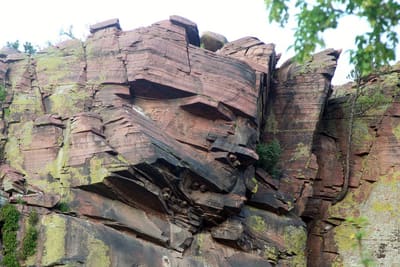
The Lyons Formation: the rock was here first -
1880–1881Wikipedia, Lyons, Colorado
Edward Lyon buys the rock
Edward S. Lyon, from Connecticut, bought 160 acres at the confluence in 1880 and platted the town in 1881, naming it for himself. The quarries opened on the hogbacks around it and the school, a two-storey block of the same stone, went up the same year. That schoolhouse is the Redstone Museum today.
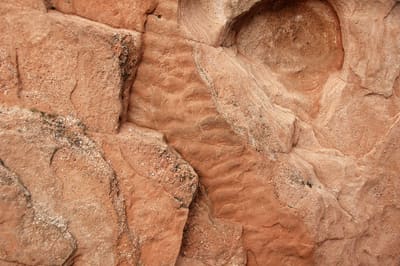
Ripple marks in Lyons Sandstone, a Permian shoreline set in stone (photographed in the same formation at Garden of the Gods) -
1884–1885Town of Lyons, the Depot
The railroad and the depot
The Denver, Utah & Pacific reached the quarries in 1884 and the stone depot on Broadway opened in 1885, later a Burlington line. Sandstone left by the trainload for Denver, Boulder and the Midwest, and the town filled with quarrymen, many of them Welsh, Cornish, Swedish and Italian. The depot worked until the 1960s, went on the National Register in 1974 and served as the town library from 1984 until the 2013 flood.
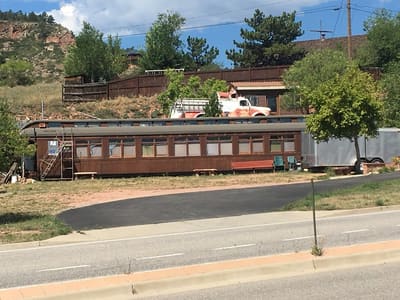
A vintage rail car at the west end of town -
1891Statutory town, Colorado
Incorporation
Lyons incorporated as a statutory town in 1891 with a mayor and board of trustees, the form it keeps. The Old Stone Congregational Church of 1894 and a run of Main Street commercial blocks date from the boom that followed. Fifteen of the town's sandstone buildings of 1870s–1917 are listed together on the National Register of Historic Places.
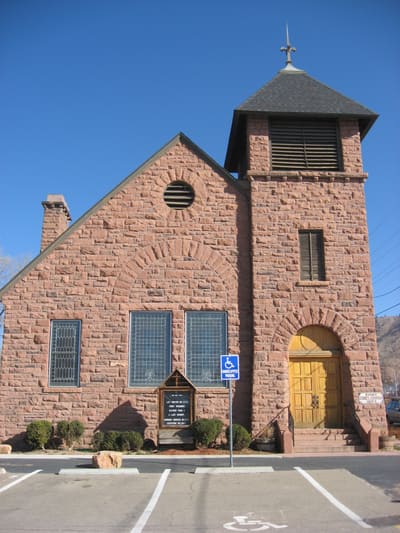
The Old Stone Church of 1894, one of the fifteen listed buildings -
Still visible today
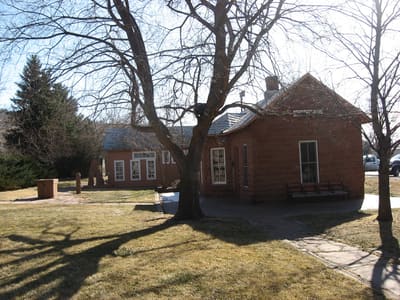
The 1885 Depot, Broadway 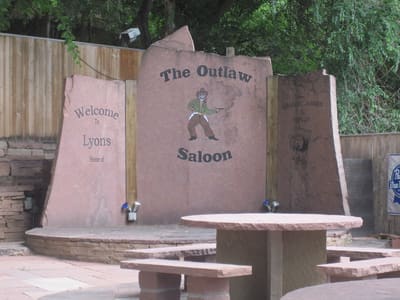
The stone is still the town's material, on a Main Street patio -
1910s–1930sWikipedia, Lyons, Colorado
Cement kills the quarries, and flagstone revives them
Portland cement and concrete undercut building stone around 1910 and the big quarries closed. The rock came back in the 1930s as decorative flagstone and veneer, and it is still cut in the hills around town today, on a smaller scale, and shipped worldwide. The town settled into being the last stop before Estes Park.
-
1973–1979Lyons Redstone Museum
The Historical Society, the depot and the museum
Residents formed the Lyons Historical Society in 1973 to stop the depot being sold and trucked out of town, bought it with the Town and restored it. In 1979 the society opened the Redstone Museum in the old school. RockyGrass, the bluegrass festival that would settle at Planet Bluegrass on the west edge of town, dates from the same decade.
-
1997–2010Colorado Main Street spotlight
Beer, bluegrass and a downtown award
Oskar Blues opened as a Cajun restaurant on Main Street in 1997 and in 2002 became the first American craft brewery to put its beer in cans, a decision that changed the industry and made the town's name known far outside Colorado. The Arts & Humanities Commission began placing sculpture around town, the annual studio tour started in 2004, and in 2010 the downtown won the Governor's Award for Downtown Excellence.
-
September 2013Wikipedia, 2013 Colorado floods
The flood
After a week of rain, both forks of the St. Vrain rose on the night of September 11–12, 2013 and met in the middle of town. Every road in was cut, the water, sewer and power went, and the National Guard evacuated residents by convoy and helicopter. About a fifth of the housing was lost or badly damaged, the parks and the depot library were wrecked, and it took years of federal, state and Town money to rebuild the utilities, bridges and riverbanks. LaVern M. Johnson Park reopened in 2017 and the library moved into a new building in 2019.
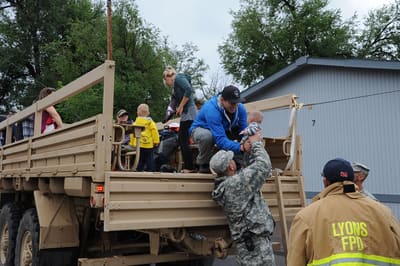
The Guard and Lyons Fire evacuating residents, September 2013 -
Today2020 census; Town of Lyons
A stone town at the canyon mouth
The 2020 census counted 2,209 people in 1.36 square miles. The downtown is an accredited Main Street America program and a state Creative District; about 97% of its businesses are independently owned. Two festivals, two breweries, a distillery, a tiny-home resort and a mountain-bike trail keep the through-traffic stopping, and the quarries on the hogbacks are still working.
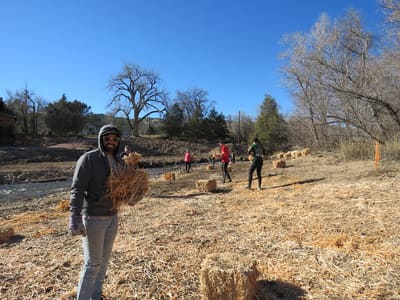
Replanting the river: the recovery, one willow at a time


The people who keep the record
The Lyons Historical Society's museum and archive is the primary source for most of this page; the Town's Historic Preservation Commission oversees the listed buildings. Corrections with a source are welcome and go in with a credit.